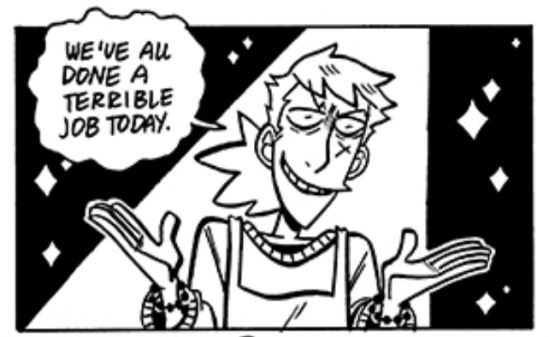


This is how we should be talking to people tbh.
Using bideogame to describe reality really resonates with people, relating videogame mechanics to the mechanics of life really helps a lot of people visually understand things.
I would go so far as to argue that japanese media where every single god damn isekai has videogame mechanics is a solid example of how so many people want to interpret the world around them in videogame language.
Describing economic precarity as an execution meter at which point you become one-shot within society with no respawns is an easier to understand concept for normies who know all these game mechanics but do not understand political or economic phrases.
I know a lot of you hate this shit but getting through to the people that have a below average education or comprehension level requires a below average way of speaking. This sounds condescending but there is no way to talk about the bottom 50% of the population other than with such honesty. If you say precarity to
 Cuno he’s not going to understand a word being said, but put it in videogame language and he will. This is important, the western left is very good at talking to educated liberals (often the more educated the better) but not very good at reaching below that where media is more successful at manipulating them rightwards than we are at speaking to them.
“your boss has lethal on you fam. you gonna get pwnd like a n00b or you gonna take the pro strat and join the union?”
fuck that might actually workCan’t believe my firm has both Culling Strike and At Will Employment
speak to your audience in the ways they are smart in
I really like this way of putting it, they are smart in videogames.
modern times require modern solutions :)
Using bideogame to describe reality really resonates with people, relating videogame mechanics to the mechanics of life really helps a lot of people visually understand things.
“Your boss stealing surplus value is like your boss ksing after you did almost all of the dps”
“M-C-M’ is like how people use real money to buy bis gear which they then use to farm valuable loot that they cash out with real money at the end of the ladder season”
“Redistribution of wealth is just a ladder reset”
It’s the age old struggle of conservatism. I have a hard time understanding why this happens and why a lot of conservatives are way more willing to subsume any new development into their movement, while enforcing their own values on it.
Like I wonder, could it be because the immaterial(theory) is the only kind of power that Traditional Marxists have left? If they let go of that, it’d be potentially a huge blow to their selves. Are they scared the plebs hate them and will eat them alive if they try to open up?
It’s because video game theory begets video game logic. It is further mediating and alienating yourself from reality as opposed to exposing yourself to it. The desire of the isekai isn’t to experience reality with explicable video game mechanics, it is to escape reality into a world of explained video game mechanics. Language is already a mediation, further going to a world of metaphor is adding another layer of obfuscation.
I’ve never been opposed to it as an entry point, but it inevitably spirals into tier lists and meta talk, which are not compatible with Marxist thinking. If we are to make metaphors here, reality for Marxism is more like a 90’s point and click adventure game than any modern game. There is alot more backtracking and absurdist puzzle solving than most people enjoy. Once the logic is uncovered, it makes sense, but usually only in hindsight, and sometimes not at all.
The only thing I do advocate for using videogames for is that the entire thing is a developed experience created by humans. No video game is naturally occuring, just like human society.
If you’re not opposed to it as entry point, what’s the issue?
My proposal is simply to make socialism more appealing to broader set of people, so that when shit goes down, when material conditions force them into action, they’ll choose to ally with us and not the fascists. We’re not going to get them to ally with us by taking away their treats.
Even if we had the military might to force people to bend to our will, we certainly do not, that’s not going to turn them into comrades. They have to make the choice themselves. I believe most people would like to, but they’re scared and abused by capitalism. I don’t believe that throwing big words at them and telling them that video games are evil is gonna get them on our side. We have to educate them to make that choice any ways that they understand and get them to move further down the pipeline.
We are extremely alienated, from each other as well. We don’t need to divide ourselves any further, if my methods prove to be ineffective, then life will teach me and I will adapt. No words are needed to teach me that lesson and no words can teach me that lesson. They’re just tools to plant the seed in my mind, that life will kick into action.
You misunderstand me.
It’s not about taking treats away, it’s about how you understand reality. If you go with video games as your entry point, you will inevitably have to contend with ‘git gud’ culture, which is logically and structurally reinforcing. This is because games are a super-structural entity that reflects the dominant culture. Our goal, as Marxists, is to understand, and help others understand, the base that creates this super-structure, not to explain the base using the metaphor of the super-structure, because that makes the super-structure seem natural, permanent, and inevitable, when it is anything but.
As such it works ONLY as an entry point, but then must be immediately discarded because it is a metaphorical construction.
We work best when we lay out these fundamental truths in easily explicable ways that accurately describe reality, and are believed not because we use good metaphors, but because we can accurately describe and explain a person’s lived experience, and give a reasonable method forward. Our struggle at the moment is presenting the reasonable way forward, not accurately describing reality.
For example, you can say ‘Use a better meta, join the union.’ but that does not combat ‘Fuck you, I don’t need to play the meta, I’m just built different.’ which is an incredibly common attitude among gamers because most gamers are complete shit at games.
If you instead go, ‘Join a union, at least then you can know the face of the person that is fucking you.’ that usually gets a better response because usually people know they are getting fucked, and think that they will also be fucked by the union, but if you present it as a misanthropic but clarifying action, they will be in favor of it. This doesn’t work when people don’t think they’re getting fucked, but those people are a minority. It also is an entry point that fundementally misunderstands Marxism, but it at least sidesteps the issue of the super-structure.
Ultimately though it about who your audience is, I agree. If you are successful with it and manage to translate it into real understanding, I applaud you.
Trying to simplify “Join a union” is absolutely not a good idea. That’s literally Pokemon go to the polls
 type of stuff.
But the article isn’t about simplifying marx into gamer speak. That was not my intention. Videogames are just as fake as the Economy, it’s not difficult to pivot into real world problems from bideogame problems and arrive at the root cause of them and how to address them, because the root cause is ultimately the same, that’s why gamers are so miserable and why they should stop gaming and join a union, because their life doesn’t have to be filled with misery. That’s it really. Like you said that is the only function they can serve.
But I’m not here to argue I just don’t want to be misinterpreted. I don’t have access to ADHD medication so it can be difficult, probably should quit doing commentary tbh it’s happened to many times already. I’m grateful that people take the time to correct me and making sure I don’t cause harm. I try to stick to just linking theory to people to read although it can make it seem like I’m being dogmatic so it’s complicated. I just hope any of the orgs I reached out to respond, but they haven’t so I just come here to try to be useful, but you tell me maybe I’m just doing more harm than good. I would gladly leave if I’m a net negative.
I don’t think what you are engaging in is a net negative. Any engagement is good, though it would be better to be doing it irl, obviously. I’m the same way, it’s not that what I view you doing as harmful, just not really theoretically correct. My thing is that it is basically one step forward, one step back. Now, maybe that step backwards is necessary to take two steps forward, idk, but I am personally arguing that it isn’t and feels like we are making more work for ourselves in the future.
User “BreadDaddyLenin”
after some very light cyber stalking, i found out that they play map games and post in ShitLiberalsSay and TankieTheDeprogram
90% chance they have a hexbear account lolI try my best to help out my cousin but she’s 100% there. Any hiccup and she will be homeless. She has persistent mental health issues that she tries to get treatment for but is unable to get anyone to actually help her (her words and I know she tries). She has provisions already in place for when she eventually dips below the line of normal self care. My family is surprised she isn’t already homeless. But she somehow holds a full time+ (40-50 hours a week) job and never misses a day working in health care intake at an ER in a hospital and has had that job for 5+ years.
My brother has (as far as I can tell) paranoid schizophrenia and has barely managed to stay afloat until recently where he finally managed to irritate local police by calling them nonstop. He is incredibly lucky my parents have some amount of means to get him help and back on his feet, because I sure as hell don’t. It’s very concerning thinking about him falling through the cracks completely but I’m also barely taking care of myself, I wouldn’t be able to do much if it was mostly on my shoulders.
we’re living at 1hp while capitalism tries its best to invent fractional hp so it can take more from us
Capitalism wants to lend you HP at a 25% interest rate.
User “BreadDaddyLenin” wrote that the idea of being “one accident away from homelessness” is “incredibly true.” “I make an okay amount of money, enough to be comfortable, but I have debt, and a single accident would probably completely ruin me,” the user wrote.
So much of the system is so hilariously fragile, but goes to show how all encompassing the propaganda is.
But also based name.
Yes hello, is this the line to kill the US?


Never heard ‘kill line’ in the context of gaming. Coming from a sino site it could easily be misunderstood. Maybe there’s a better translation or concept? Like, ‘on last hitpoint?’
If this leaves the sphere of shame, and sheds the narrative of personal failure, it could prove to be catalytic.
they’re describing what we might call an “execution threshold,” maybe “low health finisher” or something like that depending on the game. doomguy could press F to heal himself off us
but yeah none of those sound quite right, “1hp” feels like a good translation of the concept
Yeah execution threshold is what’s familiar to me, but also that may be some residual WoW in my brain
“Execution threshold” is just a synonym for “kill line”. To execute is to kill. A threshold is a line. The words basically mean the same thing. This is just ambiguity in translation. It happens a lot. What can be expressed with two different words in one language with only subtle differences in meaning, another language may only have one single word for and not make that kind of distinction.
to be totally honest, I think a lot of Chinese people are living in a similar state of precarity, especially those living in a province they’re not registered to.
Not exactly the same. China also doesn’t have welfare (in fact, China doesn’t even have a SNAP/food bank equivalent) but most people can always go back to the villages and their provincial hometowns and stay with family. Life won’t be good but you can still survive without being homeless.
But you are absolutely correct that the migrant workers who are registered under rural hukou (~300 million people) get screwed the worst, and are effectively barred from accessing housing, education, healthcare, pension/insurance and public utilities in the cities they work at. For these people, the last resort is moving back to the villages and lay low.
China also doesn’t really have an unemployment problem since the 2000s and it is only since opening up after Zero Covid in 2023 that there is a slump in the economy. Back in the 2000s and 2010s, as long as you’re willing to work, you won’t find yourself homeless and if you’re willing to work overtime, you can even get relatively good pay. These days, it is getting more challenging and there is a lot of precarity about unemployment, so people are spending less and saving more, leading to the deflationary spiral we are seeing today.
The easiest way (but it’s not clear cut) to think about the difference in the US and China, is that in the US, you are fully responsible for your financial situation, whereas in China (because of the way the economy is being developed), the losses are likely to be socialized.
For example, in the US, if the housing bubble bursts (think subprime crisis), your $1 million home plunges to $500k, you are solely responsible for the losses and in most likelihood, you’re defaulting on your mortgage and the bank takes your home.
In China, because of so much wealth has been tied to the real estate, letting the housing bubble burst would cause unmitigated chain reaction across the financial sectors and even spread to the real economy, so the government has to provide a “soft landing” by any means necessary.
What this means is that if your house price won’t directly plunge from $1 million to $500k, but the fall will be cushioned in a way that you can still sell your house to another buyer at $900k (provided that the illusion of a housing rebound is maintained), then as the price continues to fall, that other buyer can still sell it to another at $800k.
The key here is government providing “soft landing” by socializing the costs - using the national wealth to slow the plunging property prices. This way, when the house finally drops to $500k, you are not losing $500k, but that loss has been spread to 5 other buyers, as well as many others’ to prop up/slow the falling price. The cost is thus socialized. This translates to people working longer hours for lower wages, with their wealth being used to provide a soft landing, but at least you won’t see large scale “falling off the kill line”. In this sense, the working class took on the burden experienced by the home-owning middle class, and cushioning their losses.
China’s response is more similar to Japan’s recession in the early 1990s. The government orders the central bank to prop up the bad loans the banks have made, and led to the “zombification” of the economy. You may see this as a failure (true in an economic policy sense), but socially, Japan went through an entire generation of high youth unemployment with extreme social stability.
Of course, there are other examples in different sectors, but the property market is probably the easiest to understand the core mechanisms behind it.
For these people, the last resort is moving back to the villages and lay low.
I’m sure the homeless woman I watched die outside my apartment is grateful that she was given the freedom to freeze to death in an urban sidewalk as opposed to living in a rural area where the state guarantees land. Which mind you is the unattainable end goal for most people my age. And before you go on your liberal diatribe about how much rural china sucks I’ve been there and it’s still better than 90% of the planet.
In China, because of so much wealth has been tied to the real estate, letting the housing bubble burst would cause unmitigated chain reaction across the financial sectors and even spread to the real economy, so the government has to provide a “soft landing” by any means necessary.
Famously the 2008 Financial crisis never involved government bail-outs of any kind and never had any effects on the financial sector. This of course has never had any real world consequence1 which definitely didn’t turn the city Detroit into a ghost town.
The key here is government providing “soft landing” by socializing the costs - using the national wealth to slow the plunging property prices. This way, when the house finally drops to $500k, you are not losing $500k, but that loss has been spread to 5 other buyers, as well as many others’ to prop up/slow the falling price. The cost is thus socialized. This translates to people working longer hours for lower wages, with their wealth being used to provide a soft landing, but at least you won’t see large scale “falling off the kill line”. In this sense, the working class took on the burden experienced by the home-owning middle class, and cushioning their losses.
This paragraph is completely nonsensical and betrays a lack of understanding of both liberal and marxist economics. Like a garbled zhihu post. A slow deflation is how bubbles are supposed to end. I don’t see how your alternative of allowing it to pop and create another 2008 financial crisis would benefit the working class. The same reduction in demand would exist in both cases, except in one case you have mild deflation and unemployment and on the other side case you have total economic collapse. Btw your whole “working class” “middle class” distinction is neoliberal nonsense, as is your “using their wealth to provide a soft landing” narrative.
Either misinformed or deliberate propoganda lol.
Esp love throwing in “socialized losses” in typical fedboi fashion.
It’s simply how the economy works.
I’ve said many times that the easiest way out of this is for the government to run the deficit spending to provide job guarantee and social welfare, but since the party does not believe in welfare (they believe that welfare promotes laziness) and instead believe in the IMF neoliberal model of balancing the books (i.e. keeping the deficit spending low), this is actually one of the optimal ways it can work given the self-imposed constraints.
As I said, a lot of similarities with how the Japanese handled their growth stagnation - sacrificing youth employment to preserve the existing employees and the corporations that have made bad investments. Hence the high youth unemployment in China right now. None of this is a coincidence once you understand how the economy works.
hey believe that welfare promotes laziness
Lower stage of socialism. Read state and revolution buddy.
As I said, a lot of similarities with how the Japanese handled their growth stagnation - sacrificing youth employment to preserve the existing employees and the corporations that have made bad investments. Hence the high youth unemployment in China right now. None of this is a coincidence once you understand how the economy works.
The Chinese liberal obsession with Japan, an economically, politically, and culturally irrelevant vassal state of the US, never ceases to agitate me. You want keynesian stimulus, the very same thing which created America’s financialized economy with no real productive capacity. Providing young people with do nothing jobs in the city doesn’t fix anything material, it just makes line go up.
Given that 90% of people own their homes in China with 80% of those being owned out right, there’s already a huge difference. On top of that, healthcare costs in China a minimal, there is great public infrastructure, and food is cheap. Being poor in the US is vastly worse than being poor in China.
You need to understand what 90% homeownership in China actually means.
In China, your hukou (i.e. where you are born, or rather, the residence of your parents) determines your access to housing, education, healthcare, pension/insurance and public utilities in the urban areas. There are ~40% of people with rural hukou registration that are effectively barred from what urban citizens get to enjoy - not completely, but it’s extremely limited.
Currently, there are ~300 million migrant workers (农民工) in China (~40% of the 700+ million total labor force, and nearly the entire population of the US!) who work in the cities but their rural hukou registration limits their access to housing (and education for their kids - both are connected, see below).
Migrant workers are the true underclass that makes your cheap iPhones and build all those amazing infrastructure across China, yet because of their rural hukou registration, are not entitled to public utilities in the cities they work in, because technically they are not residents of the cities they work in. Your home is tied to the village/provincial town you came from. This allows the municipal governments to exploit their labor while providing minimal services in return. (Remember, there is no personal income tax in China (only 70 million people have to pay income tax), the most important tax revenue is value-added tax, so the more labor hours being squeezed out of the workers, the higher tax revenues the local governments receive).
Similarly, employers are not obligated to contribute to pension funds and insurances (五险一金) so migrant workers usually get screwed the worst because they have little to no safety net if they get sick or become unemployed.
It is class division based on where you’re born.
Now, on to housing, more than 60% of them live in rental units, ~20% live in company-provided hostels/dormitories (shared living spaces) and a proportion of them (~20%) did purchase houses (especially with marriage and kids) but mostly in the provincial towns. A lot of them were scammed into purchasing houses because the local governments, in an attempt to drive up land prices, tied education resources to housing, and effectively coercing these migrant working class families to purchase a house in the county in order to even have a chance of sending their kids to public schools due to the points-based system that prioritizes home ownership:

According to Prof. Wang Ou’s research (see my linked article above):
So, how much does it cost for a migrant worker to buy a home in the county? While staying in newly purchased apartments of migrant workers, I calculated the expenses carefully. In a county in southern Jiangxi, homes cost 6,000–7,000 RMB [$852-994] per square meter; in a county in western Guangxi, 4,000–5,000 RMB [$568-710]. A 100-square-meter shell apartment plus full fit-out costs at least 600,000–700,000 RMB [$85,215-99,418]. This is an enormous burden—often draining the savings of two generations and still requiring loans for ten or twenty years.
And this was back in the 2010s, when the property prices were still appreciating. You can imagine how these migrant workers are now having a much harder time paying mortgage for the next 10-20 years as the economy is undergoing deflation. All of those who bought houses after 2017 are getting screwed.
Also, your linked article was from 2016… when the property prices were appreciating like crazy. That illusion has been shattered since 2021.
The point is they still have a place to go to. The worst case scenario is far better than it is in the US. Meanwhile, seems to me that property prices going down means housing will only become more affordable in the long term. Sucks for people who decided to invest in housing speculatively, but it’s a very good thing overall.
Agree that they still have places to go (in the US you’d be homeless), but disagree that the property prices falling is a good thing overall.
The local governments have tied their budget to land finances and as you can expect, the plunging property prices are now leading to a deflationary spiral, especially with the US gating their imports from China with tariffs. The property prices falling means less spending from the home-owning middle class (who contributed the most in consumption), and with that low domestic consumption also means business profits being cut and layoffs for the employees, and less value-added tax revenues for the local governments. That’s why you have wage reduction and growing youth employment in China today - unthinkable before Covid!
The deflation also means that local governments that had taken out massive debt for infrastructure building will find it more difficult to service those debt. So, it’s the entire economy that’s getting affected, not just the home buyers.
Remember that deflation is even more dangerous than inflation. I already linked this in another post but read my post here about how the 1994 Tax Sharing Reform was the watershed moment that led to the speculative land finances in China.
We already know that US tariffs have no impact in Chinese overall exports which have actually grown now. The reality is that the US is fighting a trade war with the whole world, and that’s opening up new niches for Chinese exports. Meanwhile, property prices falling gradually is absolutely a good thing because it makes housing more affordable. This is not a rapid crash, it’s a gradual wind down which allows a controlled transition away from real estate being a major chunk of the economy. Housing is for living.
Meanwhile, I don’t think economy should be driven primarily by consumption in the first place. Thinking that consumption has to be at the core of the economy is just capitalist brain rot. Less focus on consumerism opens up other niches of development such as growing state enterprises that focus on things like infrastructure.
Chinese economy is in a state of transition right now, and it will be bumpy in the short term. However, overall direction is clearly positive with there being more focus on productive economy. Building out housing was a useful thing to do when there was a shortage of good housing. Now this task is done, and the economy can be directed towards other goals.
Finally, this whole talk of debt is not really meaningful. China has sovereign currency and can issue as much of it as it wants the same way the US does. Money supply should be seen as an allocating mechanism and nothing more. The government can issue currency to direct resources and labour towards projects that are in line with national goals.
Meanwhile, I don’t think economy should be driven primarily by consumption in the first place. Thinking that consumption has to be at the core of the economy is just capitalist brain rot.
A state produces to consume. If there is no demand for consumption, there is no production. This has nothing to do with consumerism or capitalism, it simply is how an economy works. People want to eat, live and enjoy life - these are all consumption and in order for the people to have that, you have to produce.
What gets twisted is the IMF promoting an export-led growth strategy that practically forces countries to run trade surpluses (accumulating foreign currencies) to put on their asset side of the balance sheet to keep their deficit low, without which the increase in domestic spending (liability side of the balance sheet) would drive up the deficit number.
As a result, this distorts what trade is actually for - exchange of real goods and services that you otherwise wouldn’t be able to produce in your own country. Instead, countries re-orient their allocation of capital, labor and resources to produce export goods to accumulate foreign currencies - in the case of US dollar, which has a free floating exchange rate, simply something that the Fed types into existence with keystrokes. This allowed the US to extract surplus values from the rest of the exporter countries by simply adding a number to the exporter’s bank accounts instead of providing something real in return.
So, export became the primary means of a developing country to “upgrade” their economy, and this strategy isn’t anything new. Before China, there was Germany and Japan. Then Taiwan and South Korea. Then the Southeast Asia before they were wrecked by the Asian Financial Crisis in 1997 (because SEA was where Japan exported its investment, which means they needed to be taken out). Only then did China came to the scene when joining the WTO in 2001.
Finally, this whole talk of debt is not really meaningful. China has sovereign currency and can issue as much of it as it wants the same way the US does. Money supply should be seen as an allocating mechanism and nothing more.
The state bank aka the People’s Bank of China has sovereign currency, NOT the local governments. This was why the local governments borrowed so much with the shadow banks aka LGFVs (before 2015) and from direct municipal bond issuance (after 2015) to invest in the massive infrastructure building.
And the reason why the PBoC isn’t directly financing these investments is because China has listened to the IMF and wanted to keep its deficit low (for the most part, stayed below 3% of its GDP and only after Covid and last year that this was increased to 4%). To keep its deficit low, China needs to accumulate foreign currencies before it is allowed to spend domestically. This is why China has been frantically trying to dump its export goods to the other parts of the world (especially the EU) after Trump launched the global tariffs, because it needed that trade surplus (foreign currencies) to add to its asset side to spend domestically.
The only thing this achieves is that China’s deficit number looks low to satisfy the IMF requirement. There is no empirical evidence that says high deficit will lead to uncontrollable inflation and unemployment. In fact, there is no theoretical foundation for that unless you believe in neoclassical economics. But the Harvard-trained economists in China all seem to take IMF’s words as sacred.
What this means is that even though the Chinese government has sovereign currency, it is not using it to its full advantage, and still relied on accumulating foreign currencies as assets for domestic currency emission.
A state produces to consume. If there is no demand for consumption, there is no production. This has nothing to do with consumerism or capitalism, it simply is how an economy works. People want to eat, live and enjoy life - these are all consumption and in order for the people to have that, you have to produce.
A certain level of consumption is obviously needed to keep up living standards. However, capitalist relations drive frivolous consumption where people consume for the sake of consuming. An economy exists to make sure people’s needs are met, that they have housing, food, healthcare, education, public infrastructure, and so on. Making disposable trinkets is not what an economy is.
There are plenty of ways people could be spending their time instead of consuming. Playing sports, having parties, going camping, reading books, studying, building hobby projects. The notion that life has to be structured around consumption is beyond absurd. I grew up in USSR, and consumption was a very small part of your daily life. Things were built to last, you didn’t constantly buy new phones, new TVs, new clothing and so on. There’s no need for that.
Local governments work with the central government. They don’t exist in a vacuum. And the central government understands the problem at least as well as you do. In fact, I would wager the experts there might even understand it a bit better.
Meanwhile, the idea that China cares what IMF thinks is frankly laughable. The reason China is doing exports is because that creates soft geopolitical power, and it helps friendly countries develop. The EU isn’t even a major export target for China anymore. The main focus is in Asia, Latin America, and Africa.
The CPC simply tends to be conservative with its policy, which is a reasonable approach to take.
Sometimes I suspect that this account is a classic case of a white guy pretending to be Chinese but when you bring up the “Chinese people owning houses doesn’t count because it’s in a rural area” it betrays a form of cretinism unique to Chinese liberals such as yourself, who like the boomer generation in America and the Soviet Union, seem hellbent on destroying your own society out of pure sheltered contrarianism.
Back of napkin math for average home price/minimum wage in Shanghai is: 13yrs vs. 25yrs in LA. I’m being generous here since home ownership is still technically possible in LA, as opposed to New York, where the majority of people rent their entire lives and never own property unless they move to the suburbs.
So in your scenario, your migrant worker starts off already owning a home in a rural area, has an easier time affording both rent and eventually buying a second home. In the American scenario you start off not owning a home, have to spend more of your income on rent, with the alternative being living on the streets (which will impact your ability to get a job again if you don’t end up dying). It’s unlikely that you’ll be able to afford buying a home in an urban area at all, and in the best case scenario you save enough to buy a house in the suburbs, which is the starting point of the migrant worker.
Given that I’m likely to be living out of my car at the end of this month, I want to personally tell you to go fuck yourself. I hope the CPC throws your ass in a gulag before you and your ilk destroy your country.