

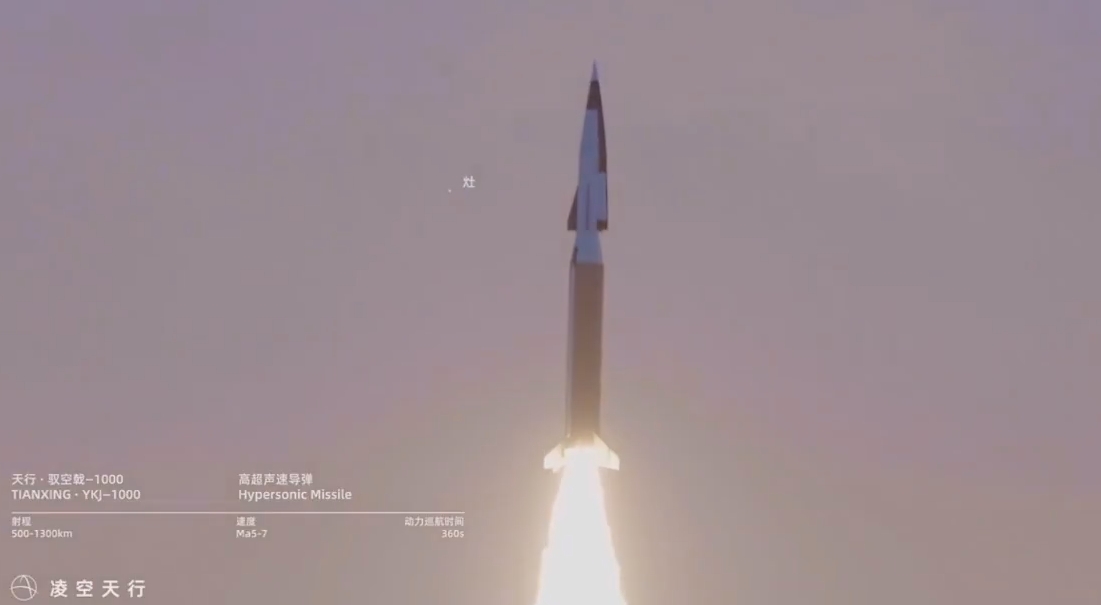
It breaks my heart seeing China forced to waste money on ‘defence’. This missile is a staggering achievement, but China shouldn’t have to do this just to survive. Imagine how nice this world could be, if only the West would de-escalate. They got so high on the soviet collapse that, just like ww1 Europe, they believe their own propaganda.
it sucks that the west is run by absolute demons but it does feel like China has figured out how to thread this needle
they spend just enough on just the right things to deter attack, keep the west tilted and throwing infinite money into wunderwaffle black holes, and avoid wrecking their own economy. like, does anybody in the PLA Navy actually think they need aircraft carriers? doubtful. but every time they build one, as cheaply as possible, Washington loses its stupid cracker mind
Fortunately, they seem to be threading the needle better than the USSR did - China spends way less of their national productive output on military shit than either the USSR, or the present day USA, while maintaining a very credible defense.
The silver lining is that a lot of this tech will have use in the civilian sector as well, but generally agree.
Pizza delivery by icbm
Intercontinental Bufala Mozzarella
That’ll cause an incontinent bowel movement
Sit on the toilet so long but leaning more to one side you get incongruent butt marks
Hypersonic trains
At the very least this missile is cheap compared to what we have in the US.
Fools. They’r emissing out on such lucrative grift.
what kind of financing options are there?
huge coin discounts on aliexpress
delivery can take up to six weeks and it doesn’t even come with a launching platform
you can pick expedited delivery and they’ll launch it straight to you

standing in the street shuffling left and right with my arms up over my head ready to catch it

you have to scroll down and pick the option for included launcher when you’re adding to cart, easy to miss in the app
Yeah, well statistically our F150’s have far higher lethality rates

deleted by creator
Similar survivability to a cybertruck too
Fantasizing about riding a hypersonic missile to work like Calvin flying an airstrike on his school.
so what youre saying is if i really put my nose to the grindstone i can buy a hypersonic missile for recreational purposes
Can we upgrade you to a McNuke, sir?

 Supersize me
Give a bunch to Yemen and Venezuela, cowards

Yemen already has this kind of technology , due to co-operation with Iran. What do you think all those missiles fired at Israel and the US Navy were?
Fattah-1 debris ended up in Israel from missiles launched from Yemen
This seems to be part of the marketing campaign for the PLA (Chinese military) to buy the missile. I have significant doubts that the PLA will purchase it. There’s a big difference between a glide vehicle or maneuverable re-entry vehicle that can hit hypersonic speeds for a brief moment before significantly slowing down and maneuvering at a big cost to speed and energy, vs sustained hypersonic speeds for the majority of its flight. The PLA (and the US military) are looking for the latter. And they have both demonstrated the latter in testing already, with the DF-ZF glide vehicle for the DF-17, and X-51 Waverider respectively. The X-51 achieved 240 seconds of powered flight, 200+ seconds of that being hypersonic flight utilising a scramjet. Those are the kind of figures that the US and China are interested in. The US is looking to minituarise the X-51 design for a tactical weapon carried by fighter jets.
Unlike traditional ballistic systems that follow predictable paths, the YKJ-1000’s glide phase introduces dynamic manoeuvrability, permitting altitude shifts, lateral displacement, and abrupt course changes designed to degrade missile-defence radar tracking and intercept algorithms.
The more advanced ballistic missiles with maneuverable re-entry vehicles have been doing this for over 40 years. Look at the Hera Moving Target Vehicle, based on the Pershing-II, for example:

The YKJ-1000’s avionics suite integrates consumer drone cameras, automotive-grade processors, and mass-produced BeiDou navigation chips, enabling unprecedented cost savings while still maintaining functional target-acquisition capability.
So definitely not flying at hypersonic speeds in the terminal phase if a consumer grade camera is able to make out a target. (Plasma sheath, how is the camera seeing through that?). Also consumer grade navigation chips for satellite navigation? Don’t see that fairing well with the mess of electronic warfare and jamming that will arise once a shooting war starts. Accuracy is quite important.
Lingkong Tianxing’s publicity officer noted that online claims of exactly 700,000 yuan (~US$99,000 / RM463,000) per unit were “not true”, yet confirmed that the missile indeed relies on standard industrial components mass-produced at low cost to replace bespoke aerospace-grade alternatives.
Of course it’s not true, you aren’t putting a payload into orbit at that price. I’m sure that this new missile is significantly cheaper than the DF-17, but the question is if China even wants cheap missiles like this, vs high end hypersonic systems that they already have. That’s a question about PLA force structure more than anything. At the moment they don’t seem interested.
This mirrors the lessons of Ukraine, where low-cost drones consistently force expensive air-defence systems to engage, draining budgets at unsustainable rates.
This hasn’t been happening for a while now. There are dedicated short range air defence systems and counter UAS (unmanned aerial systems) systems in place to deal with the UAVs.
States such as Iran, Venezuela, or Myanmar—or even non-state actors such as Yemen’s Houthis—could transform their anti-ship and anti-infrastructure strike capabilities, altering local power balances and complicating US or Western military intervention.
Why would Iran or Yemen be interested in this, they already have ballistic missiles with powered maneuverable re-entry vehicles in Fattah-1 and it’s derivatives. We already saw how these kinds of weapons stack up vs a US intervention, what their strengths and weaknesses are.
I can see use for both expensive hypersonics and dirt cheap systems like this which will still be expensive to shoot down. I would imagine what’s more important than the cost itself is how quickly and easily it can be produced. If you can have dark factories pumping these things out 24/7 then there’s no counter that the US or their toadies can have to that. If we learned one thing from Ukraine it’s that the US is structurally incapable of ramping up mass industry.
Yeah, Iran proved you don’t need the most advanced missiles, just enough to overwhelm the enemy’s interceptors. And defense is always more expensive than offense, usually by orders of magnitude.
I’m sure having a mix of both in your arsenal is the most optimal play, especially if you can hold back the more advanced stuff while your enemy is already tapping out after being hit with your cheaper stockpile.
I highly doubt that China wants to use Iranian missile strikes as a model. Iranian missiles displayed poor accuracy, which made counterforce targeting via conventional warheads infeasible. Iranian missile strikes had practically no impact on Israeli military operations. Israeli airbases still functioned, the Israeli chain of command was unaffected. Yemeni missile strikes using Iranian designed missiles aimed at US aircraft carriers complicated operations, even resulted in aircraft going overboard due to evasive maneuvers, but at the end of the day did not land a hit. China does not want to enter into a war with the US with that. China wants to destroy air bases and sink aircraft carriers. China, as a state actor which is a global superpower, wants their weapons to have high end strategic and tactical effects. China has little care for trying to use up interceptor stocks, they want to sink Nimitz class aircraft carriers and destroy Guam and US airbases in Japan within the first few hours of a conflict, or at least have a credible capability to do so, to establish deterrence.
Exactly, once they run through the interceptors, then you start to hit stuff with your good missiles.
If we learned one thing from Ukraine it’s that the US is structurally incapable of ramping up mass industry.
Does China want to fight that kind of war though, a drawn out multi year attritional war where a city with a pre war population of 60 000 takes 15+ months to capture, a war in Ukraine that has gone on for longer than the US campaign against Japan in the Pacific during WW2. I doubt China wants to fight that kind of war over Taiwan for instance. If China wants to seize Taiwan, they would want to be quick and decisive, and to deter any US intervention either out of fear of Chinese capabilities, or by quickly sinking an aircraft carrier or destroying US airbases if the US does intervene, in a forcible display of Chinese military capabilities. That’s what my read is right now.
I can see use for both expensive hypersonics and dirt cheap systems like this which will still be expensive to shoot down
Some sort of Hi-Lo mix could be useful, I can see the value in that. There are always lots of targets to prosecute in war, and not everything needs a high end system to hit it. In that case, it just needs to be more difficult to shoot down than a cruise missile, and probably won’t be fired at highly defended targets. In Ukraine, Russia does this a lot, firing ballistic missiles at areas with no or minimal systems to defend against ballistic strikes. Something like this, cheaper than an Iskander-M or Kinzhal, but still very capable, would be very useful for Russia right now. But that brings me back to the first question: is China interested in fighting or preparing to fight that kind of war? Are they going to structure their rocket forces like this? I have doubts.
First, let’s remember that Russia tried to do exactly what you’re suggesting in the first two weeks. They rolled up to Kiev and gave Ukrainians an ultimatum. This almost worked when the agreements were initialled in Istanbul. Then the west told Ukrainians that they would back them to the end and that they had to fight. That’s how the war of attrition started. Did Russia want that kind of war? Clearly not. Did they have a choice in the end, also clearly not.
Similarly, China will likely try doing what you suggest, but then if the US and the vassals decide not to back down they’re going to find themselves in a war of attrition as well. However, there’s a big difference between South Asia and Ukraine in terms of logistics. While the west was able to funnel weapons into Ukraine easily through Europe, it will be much harder to do with Taiwan given that its an island. I personally can’t see how the US could sustain a long term campaign against China, especially given that China controls many critical inputs for weapons production, and existing stocks are now severely depleted in Ukraine.
So, while China would absolutely not want to be dragged into a protracted war, it would be sheer idiocy for them not to plan for one while hoping for a quick decisive win.
I’m thinking about leasing one instead
That would be awesome, buy now pay later missiles.
Isn’t that how the Ukraine gets all its weapons?
yeah but you have to return them without any scratches or you’ll get dinged for the repairs plus penalties
If you rent a hypersonic missile, you have a financial problem.
If you rent 1000 hypersonic missiles, now the bank has the problem.
If you rent 1000 hypersonics, whoever you want to have problems is going to get some.
Will they be releasing a King Ranch hypersonic missile?
I would rather have the missile than the shitty truck
what a deal
I should get me one of those
yeah but can the chinese make $40k of profit on interest alone from those rockets?
Could probably do with getting a few of these to Venezuela pronto…
I would hate to get hit with anything going Mach 7. It doesn’t even have to blow up.
It’s definitely not impacting the target at Mach 7, that’s given as the maximum or peak velocity.
Arm the working class with nukes.